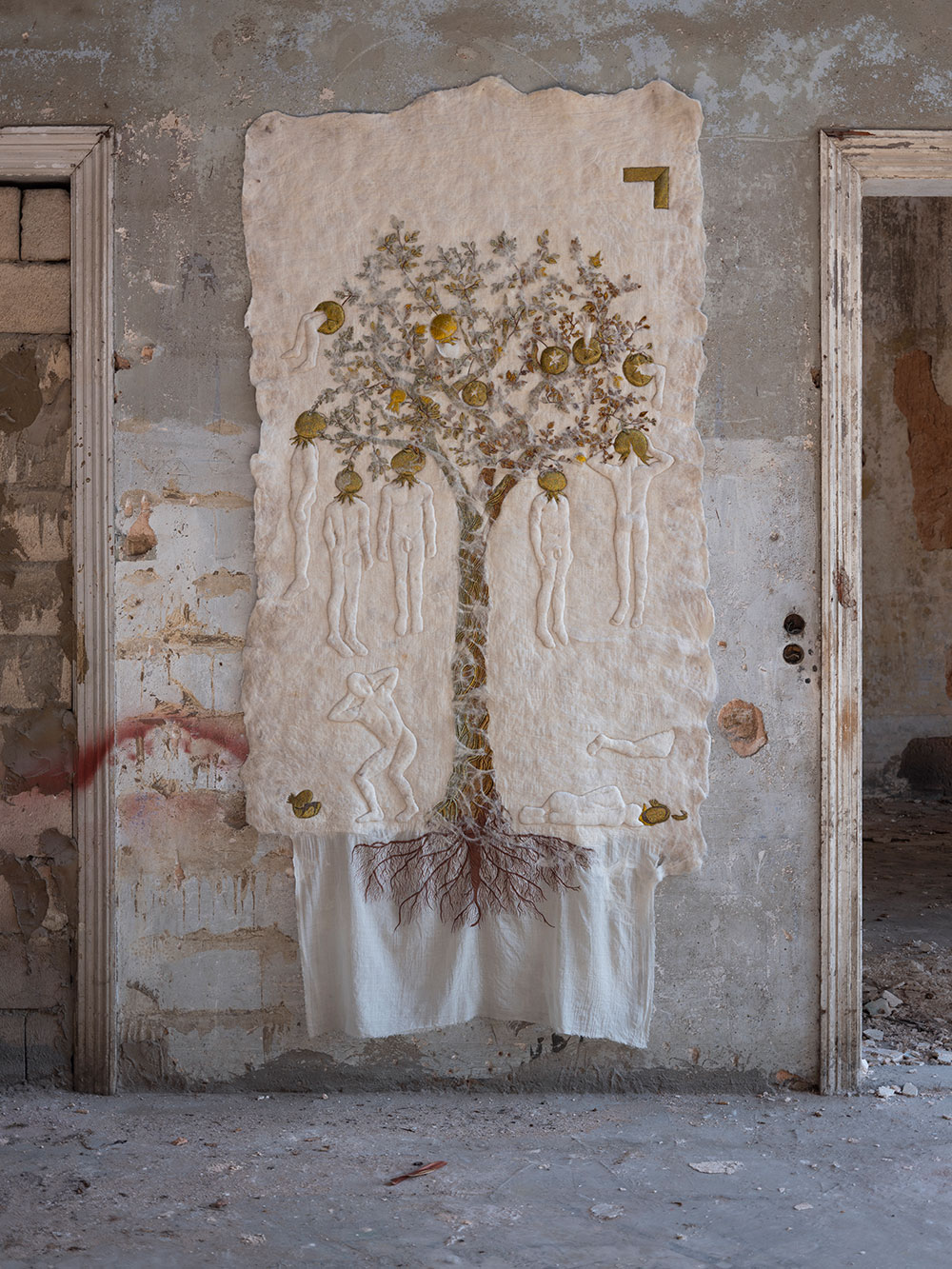
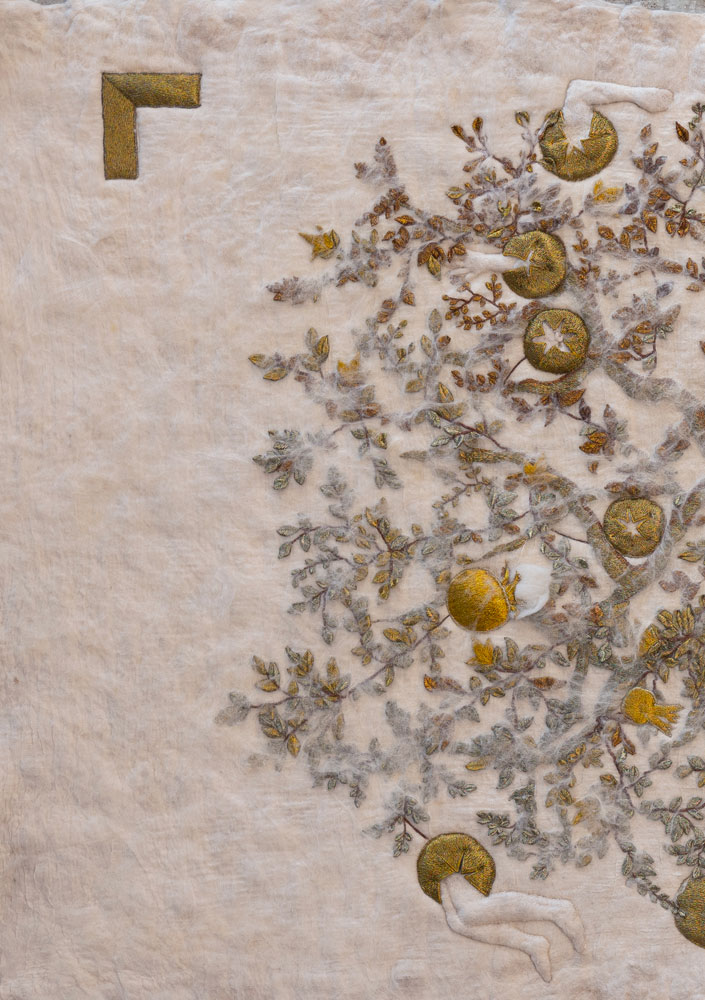
WAK WAK takes its name from the mythical island of Waq-Waq, where human bodies are said to grow from a tree and fall when they ripen. Upon reaching the ground, they awaken and cry “wak wak,” their first sound.
Circulating across Arabic, Persian, Indian and later European geographies, Waq-Waq belongs to a shifting field of folklore, travel accounts shaped by the routes of exchange linking the Indian Ocean and Silk Road worlds. Its tree unsettles distinctions between vegetal, animal and human life.
The work carries this instability into its material construction. Embroidery is embedded and partially trapped within felt, bringing together textile languages often separated by hierarchies of refinement, labor and value. The precision of the stitched image is absorbed into the density of wool, where line, fiber and surface begin to lose their independence. Narrative and material become entangled in the same way as the myth itself, blurring distinctions between body and plant, image and substance, ornament and structure.